


There Is No Such Thing as a Commodity. Only Commoditized Thinking.
There Is No Such Thing as a Commodity. Only Commoditized Thinking.
Somewhere in your company, right now, someone is saying it.
"We're basically a commodity in this market."
"We're price takers; the customer sets the price."
"Our product just isn't that differentiated, so we have to match the competition."
These phrases get said so often, in so many B2B manufacturing and distribution companies, that they've taken on the weight of settled fact. They sound like a clear-eyed read of market reality. They're actually something very different: a decision, dressed up as an observation.
Levitt called this one in 1980.
In a now-famous Harvard Business Review article, Theodore Levitt wrote flatly: "There is no such thing as a commodity. All goods and services are differentiable." And he went further, arguing that the usual presumption (that consumer goods are more differentiable than industrial goods) is exactly backwards. Industrial products, he said, have more room to differentiate, not less, because B2B buyers care about reliability, lead time, technical support, terms, risk, integration, and a dozen other things the spec sheet never captures.
Forty-six years later, that argument has held up remarkably well. And yet the phrase "we're basically a commodity" keeps getting uttered in boardrooms and sales meetings, usually right before a discount gets approved.
The self-fulfilling prophecy
Tom Peters once quoted a friend who ran a business in the forest products industry, arguably as close to a true commodity as B2B gets. The friend put it this way:
"If you don't think your product is any different from or better than your competitors', then you can be sure it won't be. Somehow or other, you'll find a way to make it no better."
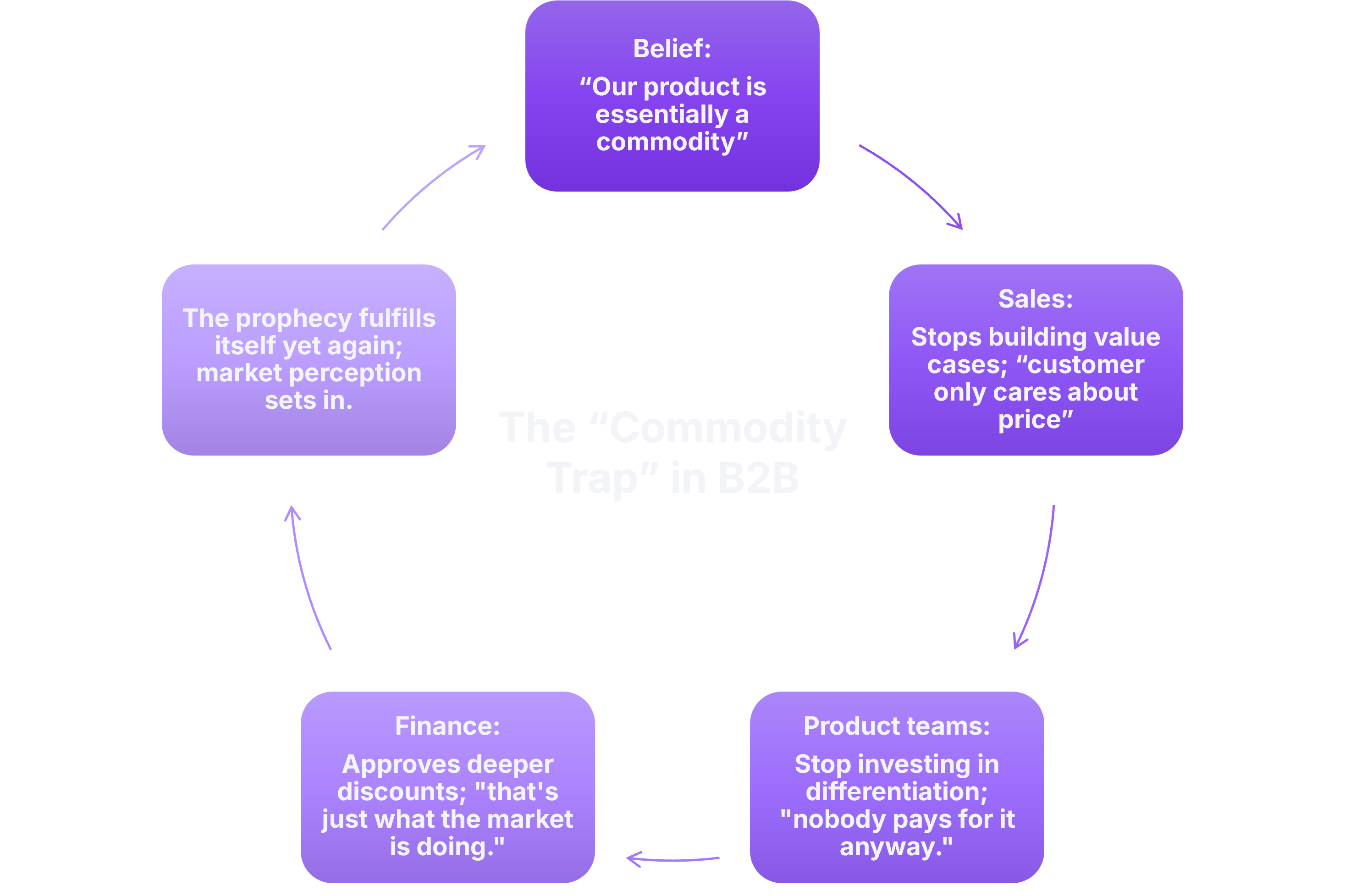
That's the mechanism. Commodity thinking isn't a description of your market; it's a posture toward it. And once the posture sets in, it quietly shapes a thousand small decisions. Sales reps stop building value cases because "the customer only cares about price." Product teams stop investing in differentiation because "nobody pays for it anyway." Finance approves deeper discounts because "that's just what the market is doing." The prophecy fulfills itself, one surrendered basis point at a time.

Hidden champions, hidden pricing power
Hermann Simon spent a career studying mid-sized manufacturers in supposedly commoditized industrial niches: specialty fasteners, filters, industrial tape, precision components. What he found, and documented in Hidden Champions, is that the best of them routinely command 20-30% price premiums over competitors selling ostensibly the same thing. Not because their products are magical, but because they refused to accept the price-taker label. They invested in the parts of the offer that buyers actually valued beyond the spec: responsiveness, application engineering, delivery reliability, problem-solving.
The market didn't make them commodities. Their competitors' mindset did. And they chose not to join in.
The question worth asking
Next time someone in your organization says "we're a commodity in this market," treat it as a hypothesis, not a fact. Ask: what would we have to believe about our customers, our product, and our selling motion for that to actually be true? And: what are we not doing that a company which didn't believe this would be doing instead?
The answers are usually uncomfortable. They're also where the margin lives.
Because the market doesn't commoditize your product. Your thinking does.
.avif)
in your inbox every week

in your inbox every week

