


How to Build a Simple Value Map for Any B2B Product or SKU
In a previous post, we talked about the different pricing methods out there: Cost-plus, Market-based, and Value-based pricing. We also noted that value-based pricing is the gold standard, but the hardest to execute.
The most common reason companies don't get there? They can't clearly articulate what the value actually is. Not in abstract terms like "quality" or "reliability." In terms a customer (and a salesperson!) can actually use at the table.
A value map gives you that language. And it doesn't have to be complicated.
Every product has value that goes beyond the spec sheet. The companies that find it (and price to it) consistently outperform those that don’t. It’s a discipline. And it starts with an exercise most B2B companies never do: mapping value deliberately, at the product or at least sub-category level.
The Formal Versions (And Why Most Companies Rarely Use them in Practice)
There are some valuable, and rigorous ways to do this. One is the VEL or Value Equivalence Line. Pricing researchers and consultants build competitive value maps that plot your product against competitors on two axes: relative price and relative perceived quality, as scored by actual customers. A diagonal “fair value” line runs through the middle; products above it deliver more value than their price reflects, and products below it are perceived as overpriced relative to alternatives.
It’s a powerful tool. And, it can also be expensive and time-consuming to produce properly. You need customer-weighted quality scores across all relevant attributes, for your product and your competitors, from a representative sample of real buyers. For a mid-size manufacturer or distributor with thousands of SKUs, doing that comprehensively isn’t realistic. Most companies apply it selectively, if at all: strategic product launches, high-revenue categories, or moments when competitive dynamics shift significantly.
There are other even more thorough approaches around the concept of value in pricing. Two pretty similar ones are EVE (Economic Value Estimation), and EVC (Economic Value to Customer), but again: these take a lot of hard work, usually done by a dedicated pricing team and/or experienced pricing strategy consultants.
So what do you do when you don’t have a big pricing team or a platoon of strategy consultants?
A More Pragmatic, Working Framework
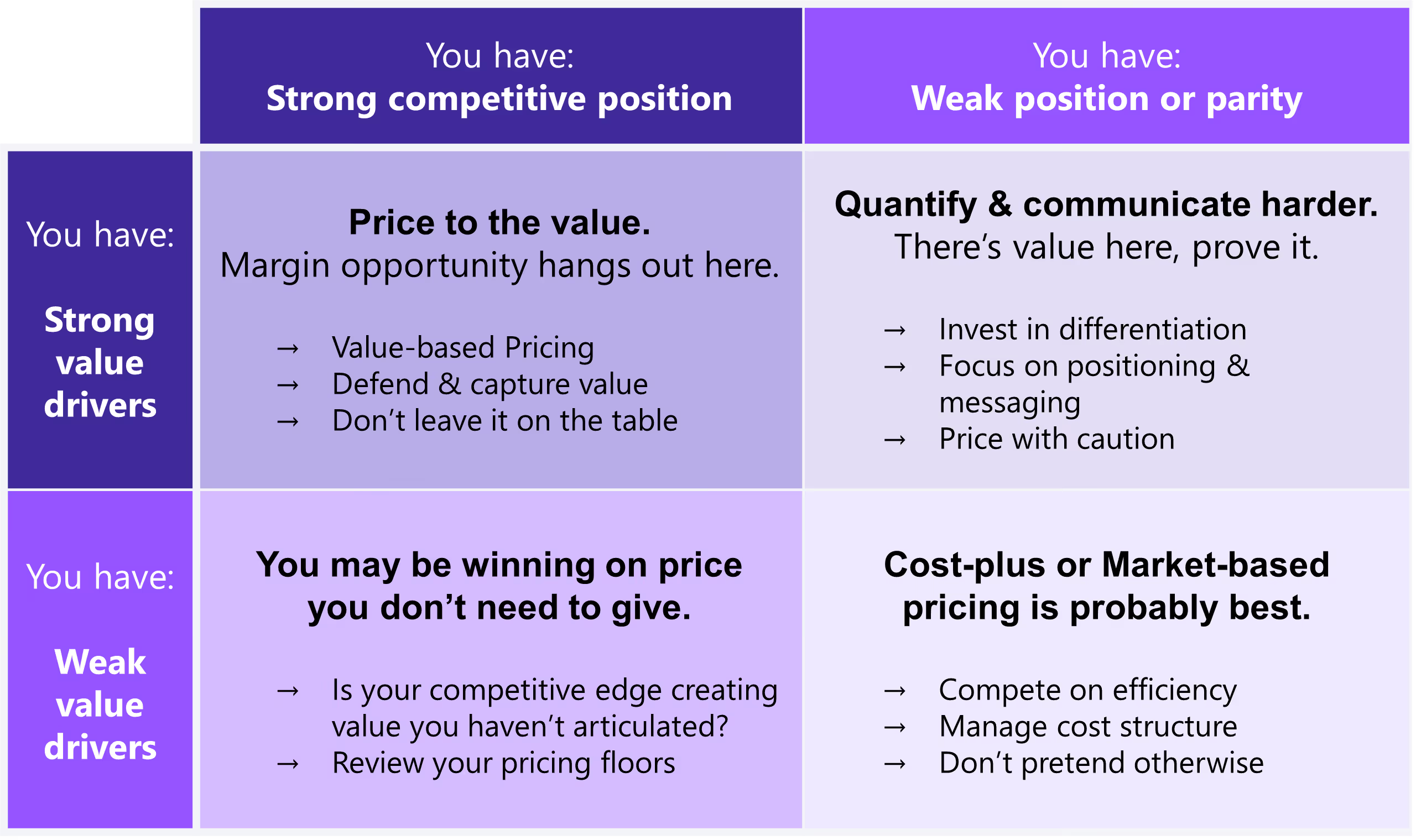
Value positioning at the product or SKU level can be described by two dimensions:
Y Axis = Value Drivers: What specific, concrete benefits does this product deliver to the customer? Think in their P&L terms: downtime reduction, labor savings, waste reduction, faster throughput, lower total cost of ownership, risk mitigation. Not “high performance” (quantified or quantifiable impact in their operation).
X Axis = Competitive Position: How does your delivery of those value drivers compare to the customer’s next-best alternative? Better, equivalent, or worse. By how much?
Plot those two dimensions and you get a practical working map:

A Quick Example
Take a cutting tool supplier serving mid-size metal fabricators. On the surface, it looks like a commodity play; there are a dozen suppliers quoting similar carbide end mills at similar price points. But look closer at the value drivers: this supplier’s tools run 20% longer between changes, their application engineers are on-call to troubleshoot setups, and their on-time delivery rate is 98% vs. an industry average closer to 85%. In a fabrication environment where an unplanned line stoppage costs thousands of dollars an hour, those aren’t minor differentiators. They’re meaningful, quantifiable drivers of customer value. Combined with a genuinely differentiated service model that competitors aren’t matching, this supplier sits squarely in the upper-left quadrant. The problem? They’re priced at market. Not because the market won’t bear more, but because no one has connected the dots between what they deliver and what it’s worth.
How to Use It
The upper-left is where most B2B companies underprice. Not because the market won’t bear more, but because no one has done the work to define and defend the value. These are products where you deliver meaningful, quantifiable customer value and deliver it better than the competition. That’s where the right to price higher exists, and where value-based pricing pays off.
The lower-right is where cost-plus makes sense. If you’re delivering commodity-level value against strong competition, don’t pretend otherwise.
The off-diagonals are where it gets interesting. Strong value drivers but weak competitive position? Invest in differentiation, or lean harder into the value story you do have. Strong competitive position but weak value drivers? That’s a signal someone should be asking whether your competitive edge is creating customer value that hasn’t been articulated yet.
Building It (Even for “Commodity” Products)
Here’s the practitioner reality: almost nothing is a true commodity if you look at the full picture. Delivery reliability, technical support, application expertise, returns handling, rep responsiveness — these are all value drivers that show up in a customer’s operation, even if they don’t show up in a spec sheet.
Start with three questions for each SKU or product family:
- What does the customer need to do with this product? (Side note: I personally love the “Jobs to be Done” framework for this exercise. It’s not just what the product does, but what job it’s doing for them in their operation.
- Where could our performance affect their cost, risk, or output? That’s your value driver inventory.
- How do we compare to what else they could use? That’s your competitive position.
You don’t need a research program to answer these. You need honest input from people who understand your products and your customers’ operations: usually a mix of technical sales, product management, and anyone who’s actually been inside a customer’s facility.
The Payoff
This map won’t set your prices for you. What it does is tell you where you have the right to price higher, where you’re likely leaving money on the table, and where you should stop fighting for margin you can’t defend.
Most B2B companies have product families sitting in that upper-left quadrant (strong value drivers, genuine competitive advantage) priced at market or below it simply because no one ever mapped the value. That’s not a pricing problem, it’s really just a visibility problem.
That’s the work.
I’m curious: have you ever formally mapped value for your products, or done any of the methods mentioned above? What was your experience? What surprised you?
.avif)
in your inbox every week

in your inbox every week

