


Pricing Guidance 101 - Guidance Your Sales Team Will Actually Use
Is the pricing right?
You help run a mid-sized electrical wholesale distributor. Around $120M in revenue, 50,000 SKUs, a couple dozen reps split across three branches. One of your reps shares a big opportunity with you: an RFQ from a big contractor you’d like to count as a new customer. The contractor wants pricing on conduit, MC cable, fittings, and panelboards for a school renovation. They need a number by Monday morning.
Your rep can easily find the list price for every item in the RFQ. He knows he can discount 10% without asking anyone. He does not know what he should actually quote. He wants to win the deal, but he knows it would ideally be “good business”. But let’s be honest; he wants the win more.
So he asks you. And you, having spent the better part of last quarter trying to determine where margin is quietly eroding, realize something uncomfortable: nobody at your company can answer that question consistently. Two reps faced with the same bid would come back with two different numbers, neither of them wrong, neither of them right.
Your sales team is missing a target - they’re missing pricing guidance.
Last week I wrote about the smallest possible pricing function: source of truth (unified commercial data), a named approver (rational policy), a monthly rhythm (core basic process). That starter kit governs how big a discount your team is allowed to give, and who has to approve it. It does not tell them where to aim before the discount conversation starts. That is what guidance does. And the best approach is often a range of values, not just a single number.
Why a range, not just one number
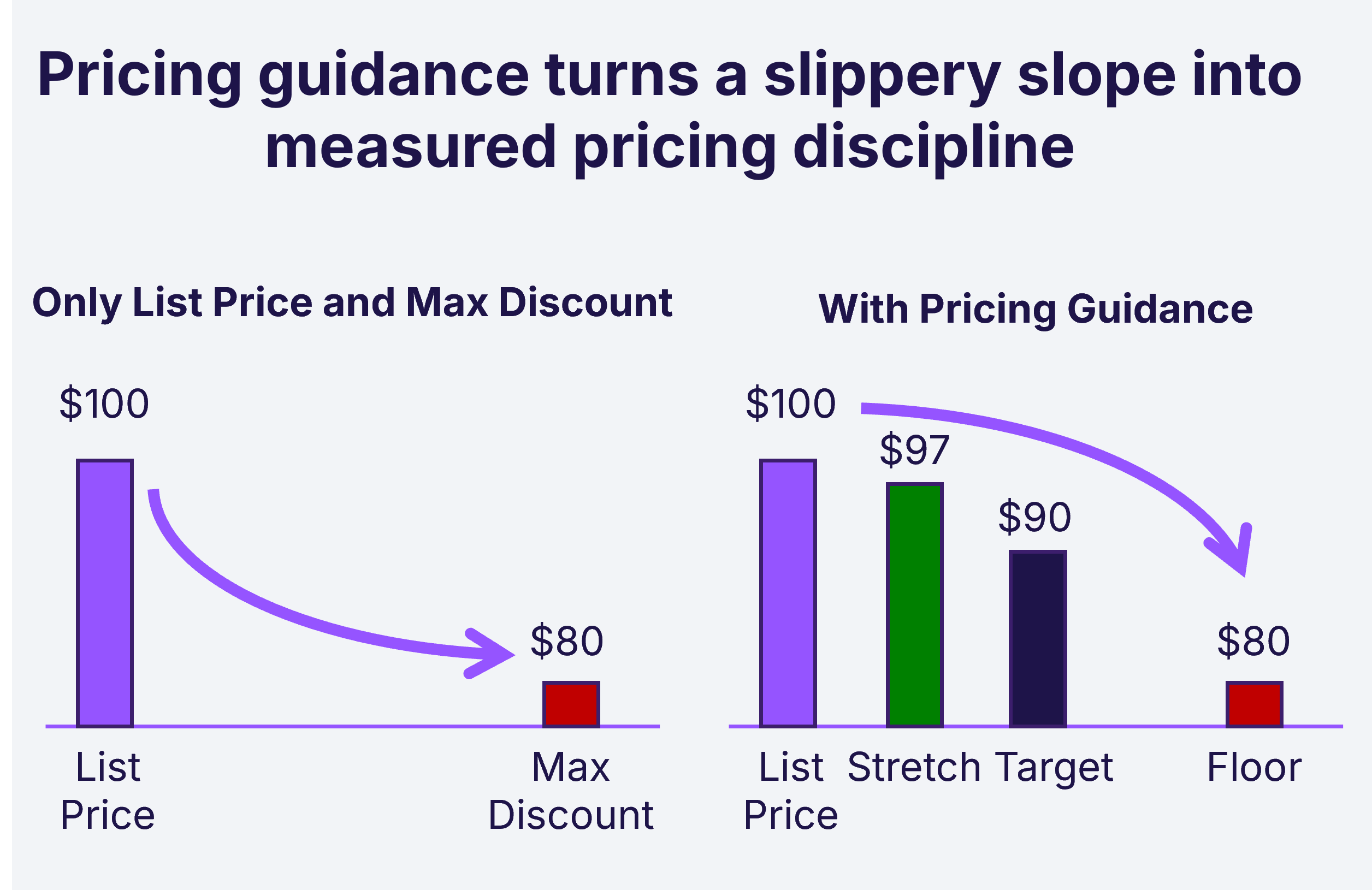
Give a sales rep one number — list price — and a max discount, and you have created a slippery slope. The default behavior is to reference the list price, then make concessions (quickly) toward the max discount.
I remember working as a pricing consultant in a large company where the sales team would say “we just need to know the price to win.” Those of us who understood pricing were shaking our heads thinking, “Well honestly, that’s a pretty easy answer: the lowest price!” But that’s not what helps the company win in the long-term. That delivers self-inflicted downward pricing pressure in your market. A race to the bottom. That’s not winning.
What you need is the “right price” - the price that wins the deal, at the highest level possible to achieve your goals. Three numbers solve this. They tell the rep where to land before the negotiation begins.
Target is where most deals should land. It is the rep’s mental anchor. Ending up at the target price should feel normal, not generous. Most deals, in most segments, against most competitors, should come in here.
Stretch is the price you charge when the value is visibly there and all the conditions are optimal. New product launch with no competitive reference. Specifying engineer wrote in your brand. Customer with low price sensitivity and high switching cost. End-of-year tax-driven buying. It’s not a pipe dream. Stretch is a real, defendable price, used in the situations that genuinely support it.
Floor is the lowest price a rep can quote without escalation. Below the floor, the discount authority matrix from last week’s article kicks in: somebody else has to approve. Floor and “absolute minimum we will accept” are different numbers, and the company-wide minimum can sit well below where any individual rep is allowed to go alone. Some companies call it a soft floor and a hard floor, or a sales floor and a finance floor.
In the image below, you'll see an example distribution of pocket prices (pocket price as % of list price). You can do the same with a simple invoice price or invoice discount as well.
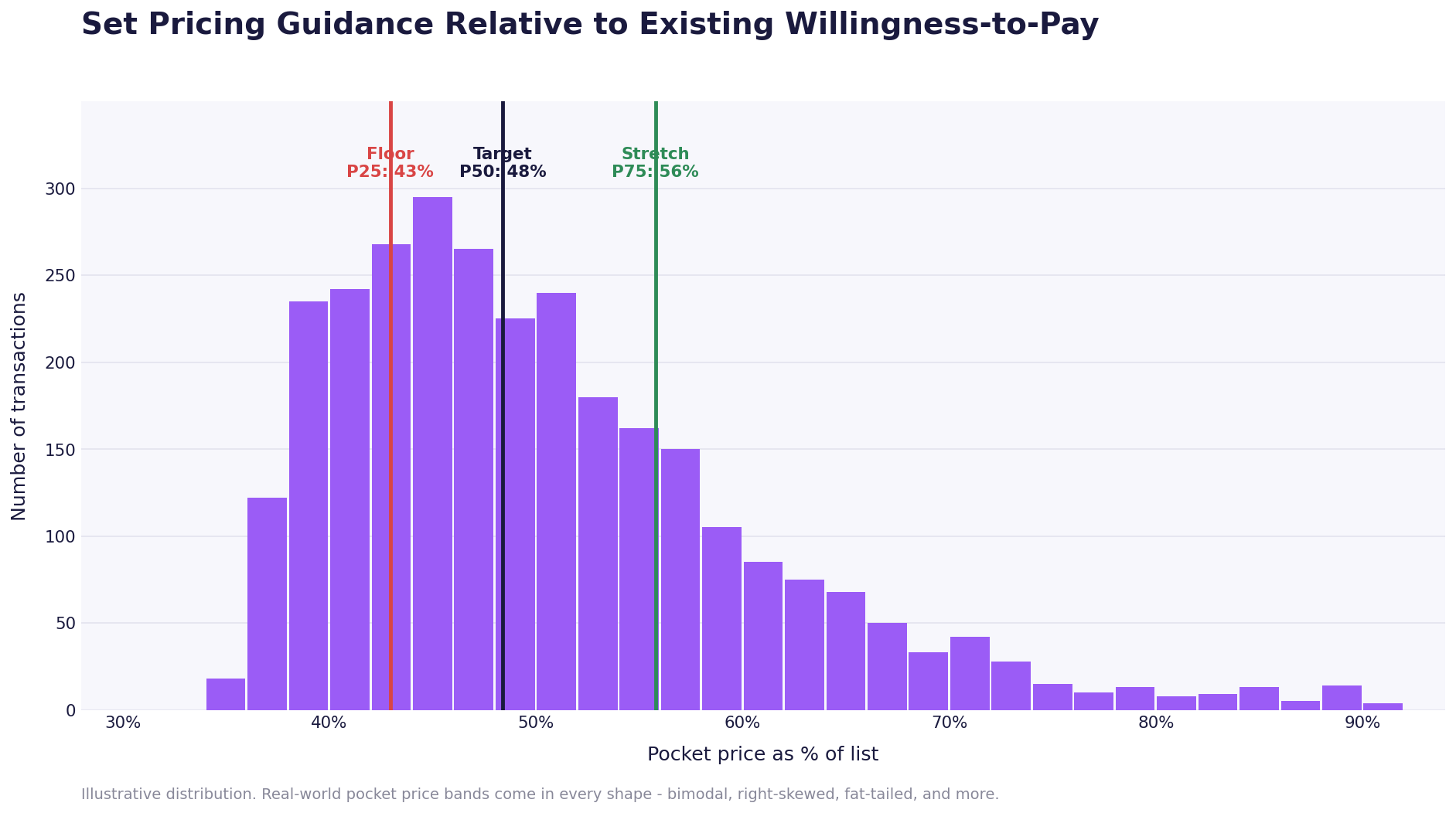
The point of three numbers is to shift the conversation a rep has with themselves before they pick up the phone. Without guidance, the question is “how much off list can I get away with?” With guidance, the question is “where in the band should this one land, and why?”
That second question is coachable. The first one is not.
Step 1: Segment, but don’t overthink it
You cannot set pricing guidance bands without segments, because the right price for a strategic national account is not the right price for a one-time online order from a contractor you have never heard of. No segmentation will result in more prices like the list price… good intentions, but doesn’t pass the reality sniff-test. But the most common mistake made when companies try pricing guidance is to over-segment on the first pass. Thirty-two segments your sales team will just ignore is worse than four segments they will use. Start with two axes or dimensions:
- Customer size — small, mid, large, extra-large. Pick thresholds that make sense for your business. Annual revenue, monthly purchase volume, total relationship value over three years. The threshold matters less than picking one and being consistent.
- Product category — how many to use is a good question. Too many or too detailed of a level, and you’ll explode the number of segments. Too few and the meaning of the segments get diluted. Find the goldilocks level. For one recent client, we were able to easily run a few scenarios to compare Category vs. Sub-Category pros/cons.
Two axes (customer dimension + product dimension), with three values each (stretch, target, floor). That’s as complicated as it needs to be for your first go at this. Yes, at some point, you could introduce additional attributes but when you move beyond a 2-dimensional pricing guidance matrix, it starts to get a little complicated to comprehend. There’s a lot of progress (and money) to be made at this basic level.
A regional electrical distributor’s customer segmentation might look like this:
- Strategic accounts (the top 20 customers, regardless of size, with formal SPAs or volume commitments)
- Large (high-volume contractors and industrial accounts, no SPA, repeat business)
- Mid-market (commercial electricians, mid-size contractors, branch-loyal)
- Small or transactional (one-off contractors, small commercial, occasional buyers)
Four customer segments. Every rep can name them. Every rep can place a customer in one within ten seconds. That is the bar.
In a real-world example, I recently worked with a distributor where we landed on these segments for customer size:
- Platinum: Customers making up the top 60% of revenue (~10 customers)
- Gold: Next 20% of revenue (~30 customers)
- Silver: Next 15% of revenue (~100 customers)
- Bronze: Remaining 5% of revenue (~400+ customers)
Step 2: Set Target, Stretch, and Floor for each cell
Now you build the guidance table where you layer-in the product categories. Customer segments on one axis, product categories on the other. Three numbers in each cell, expressed as discount off list. (You can do this in pocket-price terms once you have a pocket price view for every transaction. For a starter kit, invoice price is fine.)
For our distributor, three representative product categories might look like this. Each cell shows Stretch / Target / Floor, expressed as percent off list:
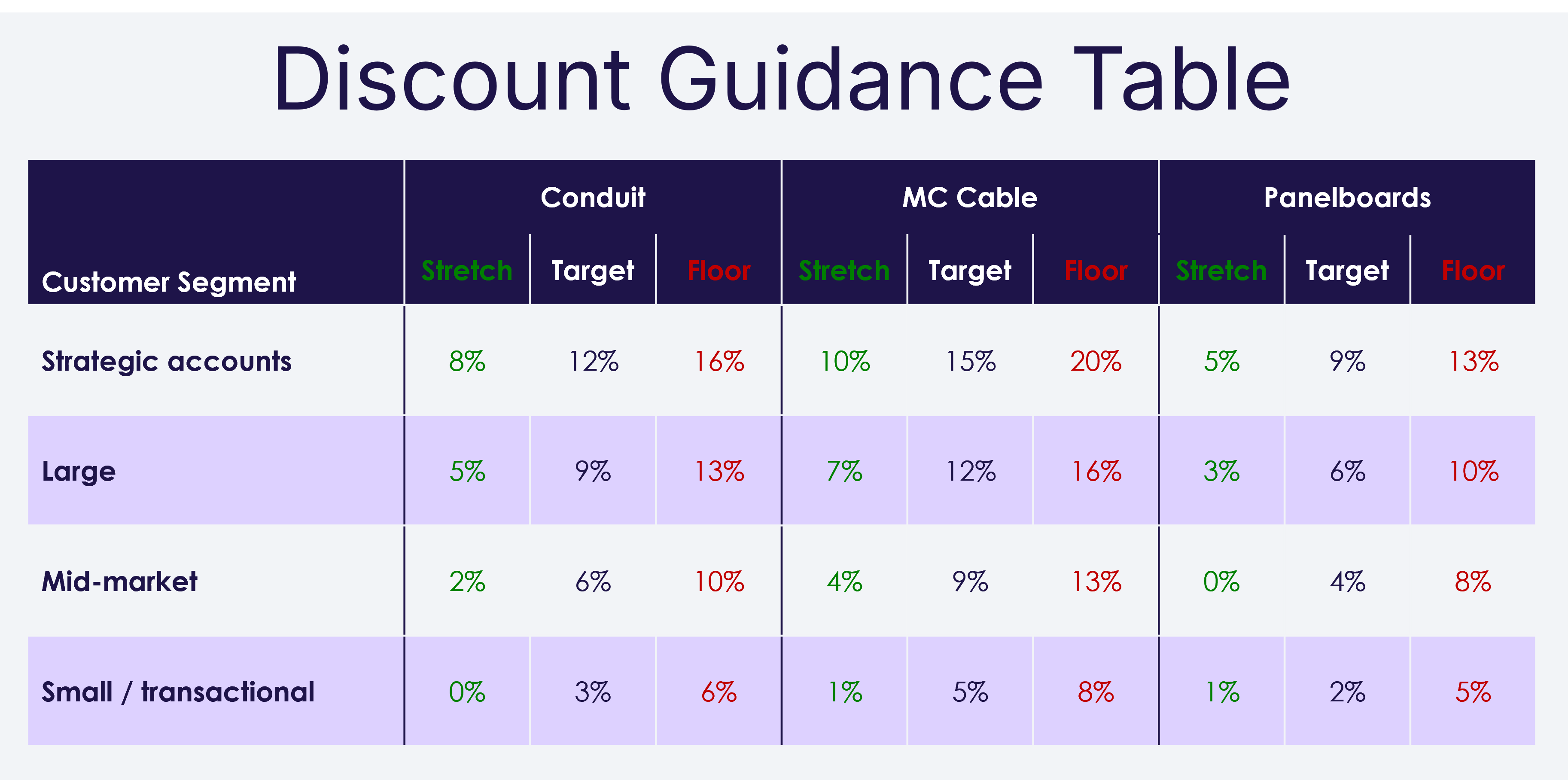
Three things to notice:
First, the bands shift across both dimensions. A strategic account buying conduit has a different target than a small account buying conduit (segments matter). A strategic account buying conduit also has a different target than a strategic account buying panelboards (categories matter). The two axes move independently, and you set them independently.
Second, the bands overlap. A small-account stretch on conduit (list) can sit above a strategic-account floor on the same product (list minus 16). That is fine and expected. The bands are guidance for a specific cell, not a global hierarchy.
Third, less-discounted categories have less-discounted bands. Panelboards in this example get less aggressive pricing than conduit because they are more spec-driven and stickier. Your real numbers will reflect your real categories. The shape is what matters: every cell carries its own three numbers.
Key Question: How do you set the actual numbers? Pull the last quarter’s quotes for the category you are working on. Bucket them by customer segment. Plot the distribution. The 25th, 50th, and 75th percentiles of winning quotes by segment are a defensible starting point for floor, target, and stretch respectively. Then adjust upward where your margin analysis says the segment can bear it, and downward only where you have hard evidence of competitive pressure. Do this for your top three to five product categories first. The long tail can wait.
Step 3: Roll it out without a mandate
Ninety days, three phases (the days are less important than the phasing). This mirrors the starter kit cadence on purpose.
Days 1–30: Build the table. Pull pocket price and quote data for your top 20 customers and top 20 SKUs. Bucket by segment. Set initial T / S / F bands for three to five product categories. Two pages, total.
Days 31–60: Validate with three reps. Not all of them. Three reps you trust to push back. Ask them where the table is wrong. Adjust. Get a sales manager and your CFO to sign off on the final version.
Days 61–90: Pilot in one branch or one product line. Communicate the table once, in person. Coach to it for thirty days. Watch what the reps quote. Track variance from target by rep and by segment, weekly. Make two or three adjustments based on what you see, then expand.
The coaching that turns three numbers on a page into a healthy habit is most of the rollout. The table is the easy part. Plan accordingly.
What changes in the sales conversation
Before guidance: “The customer is asking for a discount. How much can I give without asking?” The rep slides toward the floor by default because the floor is the only meaningful number on the page.
After guidance: “This is a mid-market regular asking for conduit pricing on a $40K bid. Target is list minus six. The stretch case here is weak — they have three other distributors quoting and a procurement-driven buyer. Floor would require my manager. I’ll quote target and hold.”
The second conversation is twenty seconds longer than the first. But it also adds 300 to 600 basis points to the realized price on that quote, every time it happens.
That conversation is what guidance produces. The table just provides the framework for the thought process and internal discussions.
What this looks like 90 days in
For a $120M regional electrical distributor that puts the three pieces in place — segmentation, bands, ninety-day rollout — the picture after one quarter typically looks like this:
- A two-page reference card sitting on every rep’s desk, or living as a tab in the quote tool
- Reps quoting target by default, stretch on a meaningful minority of deals, floor only with a stated reason
- A weekly one-page variance-from-target report by rep and by segment, distributed to sales managers
- Realized price recovery in the range of 50 to 150 basis points of revenue inside two quarters. On $120M of revenue, that is $600K to $1.8M of margin, almost entirely from arresting drift toward the floor rather than from raising list.
These are not aspirational ranges. They are what most companies see when they go from one number (list) plus a cap, to three numbers (target, stretch, floor) plus a segmentation. This is not from winning more customers or selling more volume. Just smarter pricing on deals you’ll win anyway. Your sales team just was not given a target to defend.
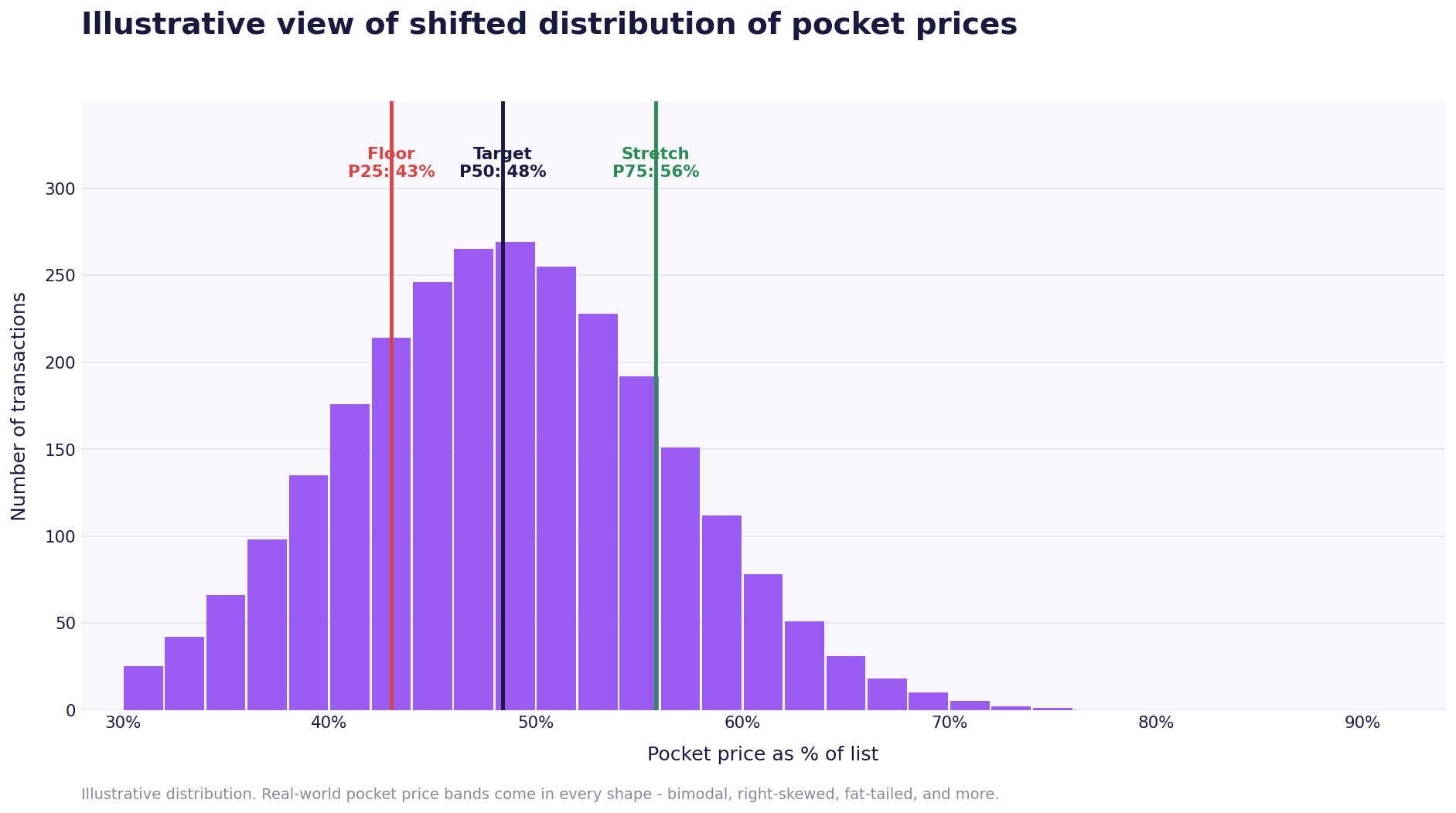
The image below shows how these simple guidance values along with some minor process change can shift the distribution to the right, which yields some huge benefits in terms of profit, though realized prices.
Where to start tomorrow
Pick the product category your sales team negotiates most often. Pull the last 50 quotes for it. Bucket them by your two-axis segmentation, even informally — a rep can do this in twenty minutes if you ask the right way. Plot quote price as a percent of list, by segment.
Look at the distributions. The shape of each one is your current pricing guidance, whether you wrote one down or not. Compare that shape to where you would want target, stretch, and floor to sit. The gap is the opportunity.
You’ll know what to do next.
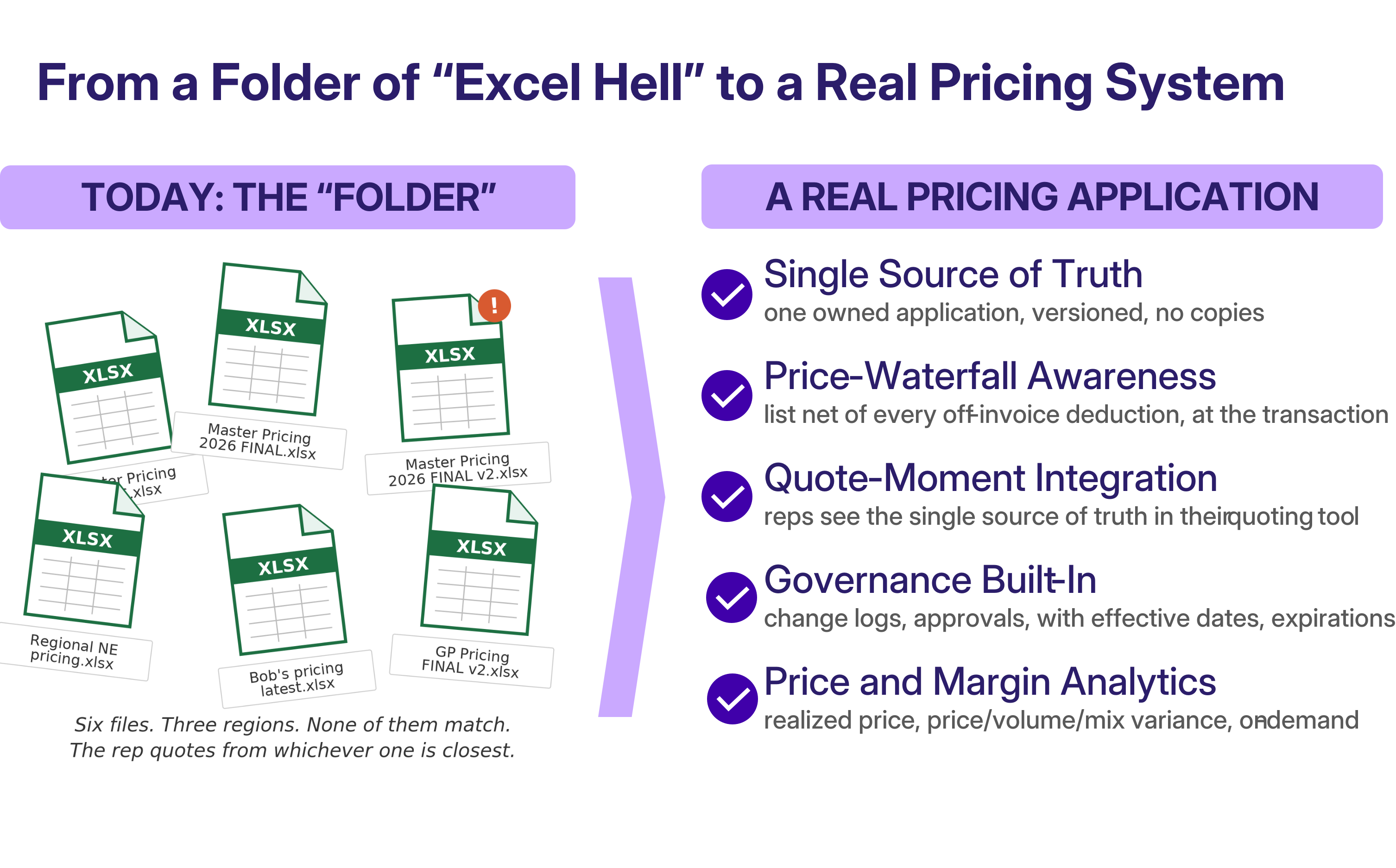
One question this article leaves open: once you have segmentation and bands, where does the table actually live? In a spreadsheet on the sales manager’s laptop. Maybe two versions of that spreadsheet, one current and one not. Maybe four, by the time three branches have edited their own copies. That is the subject of next week’s post, and it is where most of the careful work above quietly goes to die - where things like this become a “project” and not a “process”.
Pro tip: Revomo is built so that pricing guidance — segmentation, target / stretch / floor bands, variance-from-target tracking — is managed in one place using the latest data, and plugged right into the rep’s quoting environment, whatever that happens to be. If you are putting together a starter kit for your sales team and want a second set of eyes, we are happy to compare notes. The first look is on us.
.avif)
in your inbox every week


in your inbox every week