


The Price Waterfall - A Simple Primer and Why it Matters

Between your product's list price and your ultimate contribution margin, is a series of adjustments (mostly deductions) related to how your company manages it's commercial pricing and term. A few of these are well-known, but many of them are only vaguely understood - certainly not measure nor managed proactively. It's almost always a big gap.
That gap has a name. In pricing circles, it's called the price waterfall, or more precisely the pocket price waterfall. It traces every adjustment that sits between the price in your catalog or website, and the dollars that actually land in your company's bank account. McKinsey & Co. introduced the concept in the Harvard Business Review more than three decades ago. BCG, Bain, Simon-Kucher, and many other consultants have been applying it to B2B clients ever since. Tim J. Smith builds his entire pricing execution framework around it in Pricing Done Right.
And yet, across most industries, very few companies take advantage of it.
This is what I want to address with this post.
What a Price Waterfall Actually Shows
A price waterfall is a simple structure with outsized explanatory power. I can tell so much about your business once I see your price waterfall. Here's how it works: You start with your published list price. You subtract (or add in some cases) every adjustment, discount, rebate, and allowance that stands between that list price and what you ultimately collect. At the bottom of the waterfall is your pocket price: the real, realized revenue per transaction - what you get to keep in your pocket. Once you take out your cost of goods sold and some costs-to-serve, you've got your pocket margin.
Here is a representative waterfall for a B2B manufacturer, using round numbers, in a table format that's easy to read:
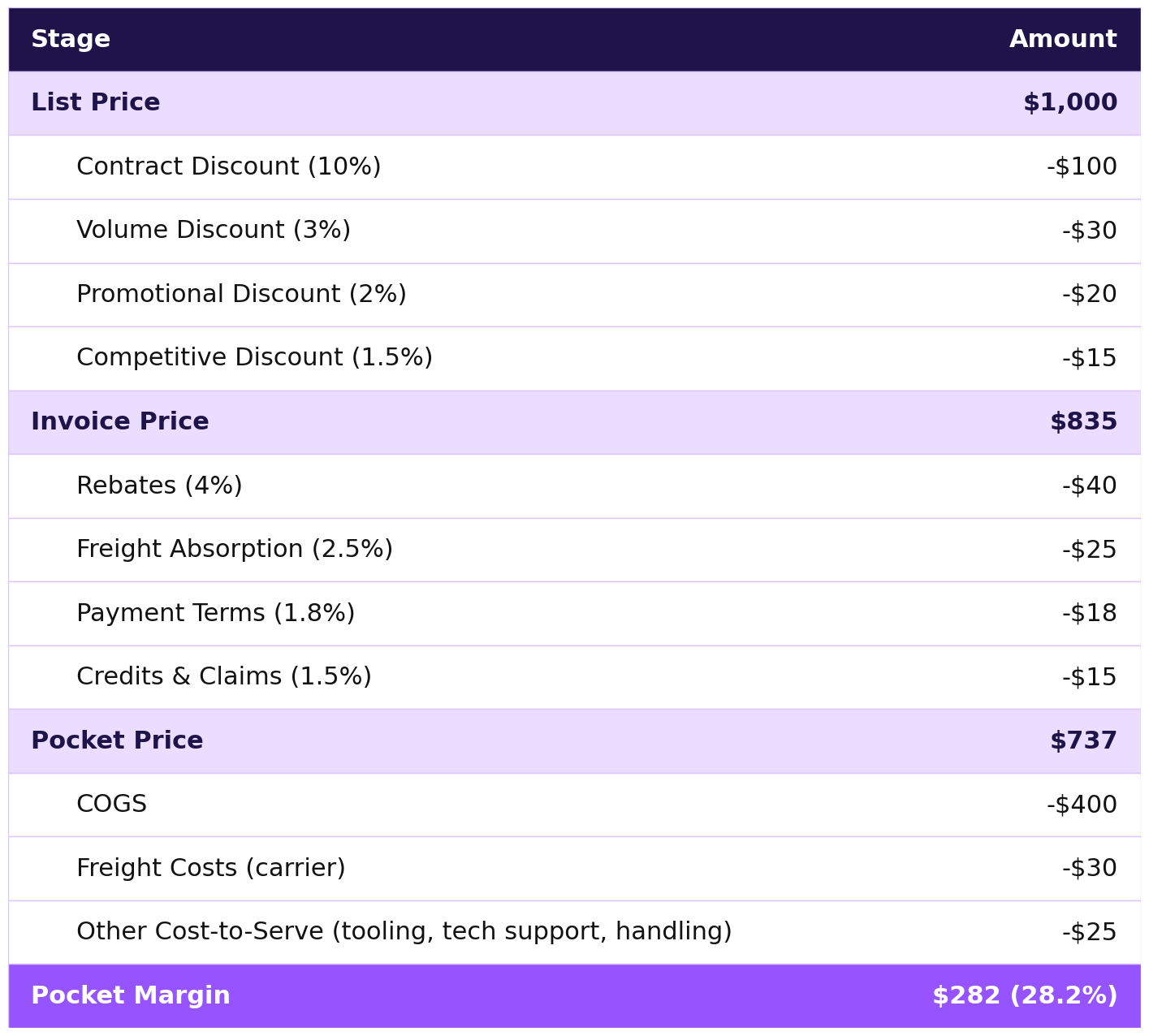
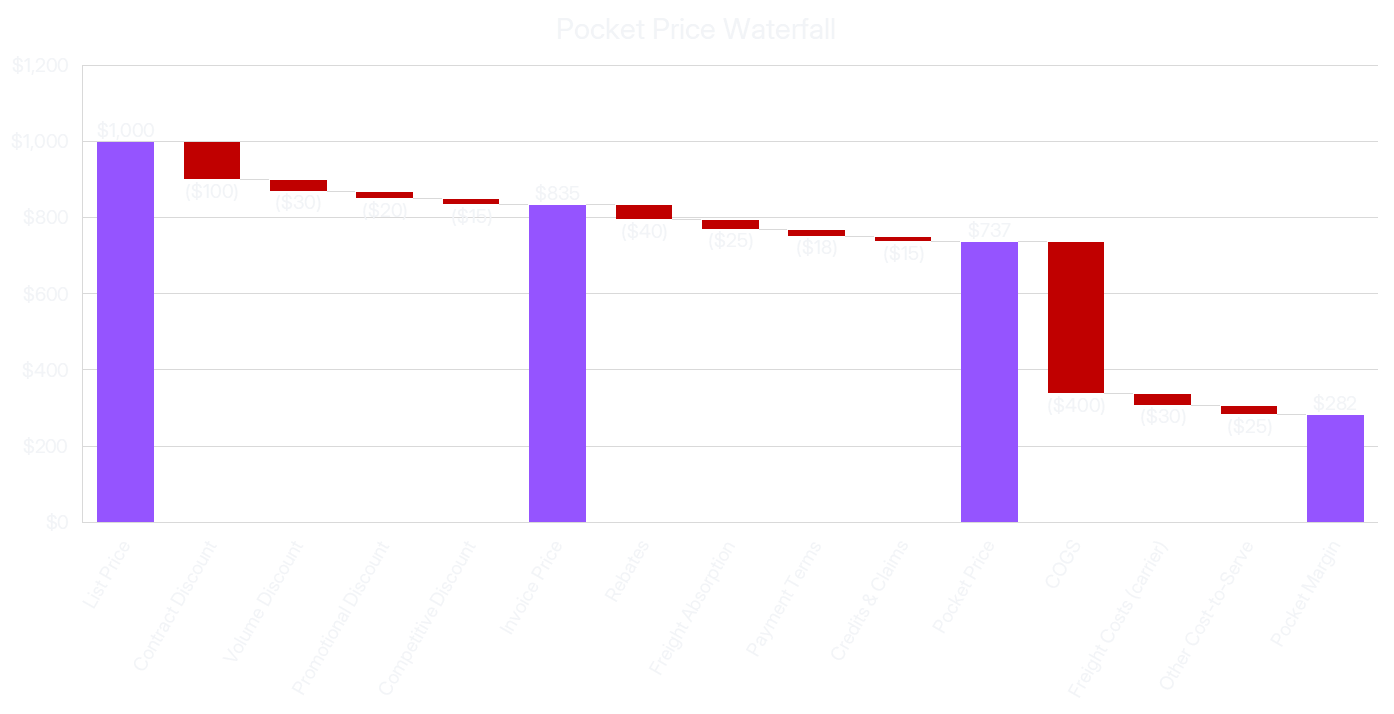
The List Price is $1,000 per unit. Pocket price is $737. That 26% gap represents money you may be intentionally giving to your customers, but it always, always, always includes a lot of money you didn't intend to give away. So think of it as a mix of intentional and unintentional leakage. The reason so many mid-market executives are surprised by their own waterfall is that most of the leakage sits in places finance and sales don't usually look at together.
Here's what that Price Waterfall would look like if you put it into a 'waterfall' chart type:
The Three Zones of the Waterfall
A well-built waterfall has three zones:
Zone 1: List to Invoice.
All the discounts that appear on the customer's invoice. Contract matrix discount. Volume tiers. Promotional rates. Competitive matches. These are visible. Your sales team sees them. Your customer sees them. They're negotiated, debated, and generally governed, at least to some degree.
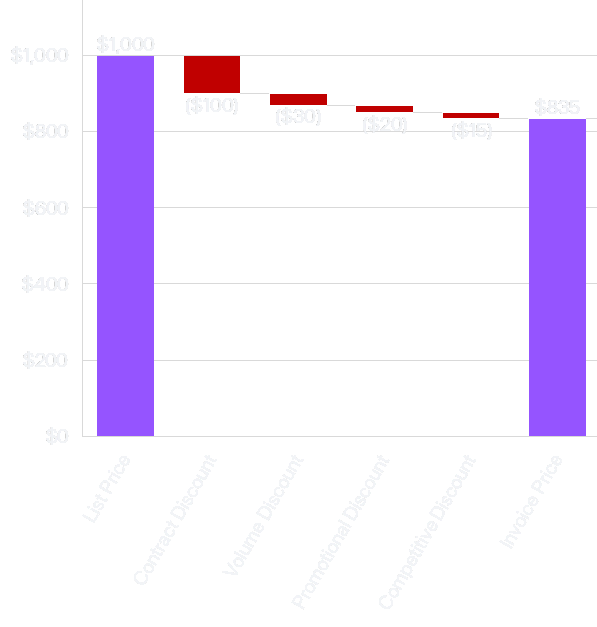
When Zone 1 is a problem, the root cause is almost always governance and discipline. Visibility usually isn't the issue.
Zone 2: Invoice to Pocket.
Every deduction that reduces what you actually collect but does not appear on the invoice. Rebates settled quarterly. Freight the seller promised to absorb. Early-payment discounts. Returns, claims, and allowances. Performance penalties for missed SLAs. This is the most opaque stretch of the waterfall, where mid-market manufacturers are most often surprised by what they find.
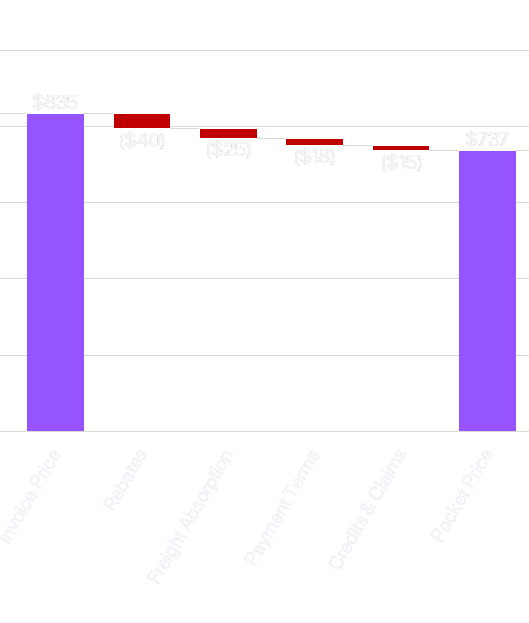
The hard work is aggregating these adjustments from wherever they live (finance, logistics, AR, trade marketing) and disaggregating them back down to the line-item level, so you can see them by customer, product, and rep. This is exactly what Revomo is built for. Feed your rebate, freight, payment-terms, and claims data into the platform and it will spread those adjustments across the transactions that earned them.
Zone 3: Pocket to Margin.
The costs of serving a specific customer. Direct product cost, yes, but also the freight you actually pay the carrier, customer-specific tooling, technical support hours, and special handling. These items don't reduce the price; they reduce the margin, and they vary dramatically from one account to the next. You probably already have COGS living in an ERP or cost system.
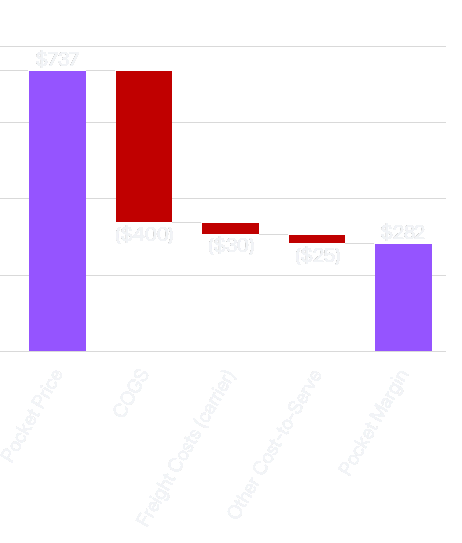
The harder task is naming and measuring your customer-specific cost-to-serve drivers and getting them into the same view as your pocket price. Feed those into Revomo and it will spread them or aggregate them so that you'll see pocket margin at the customer and transaction level, which is where decisions actually get made.
Averages Hide the Damage
One more warning before you build your own waterfall. The average is a lie. The average is hiding the truth, which is a lot of variation that is just rolled up to one average number. The size and shape of the distribution is everything.
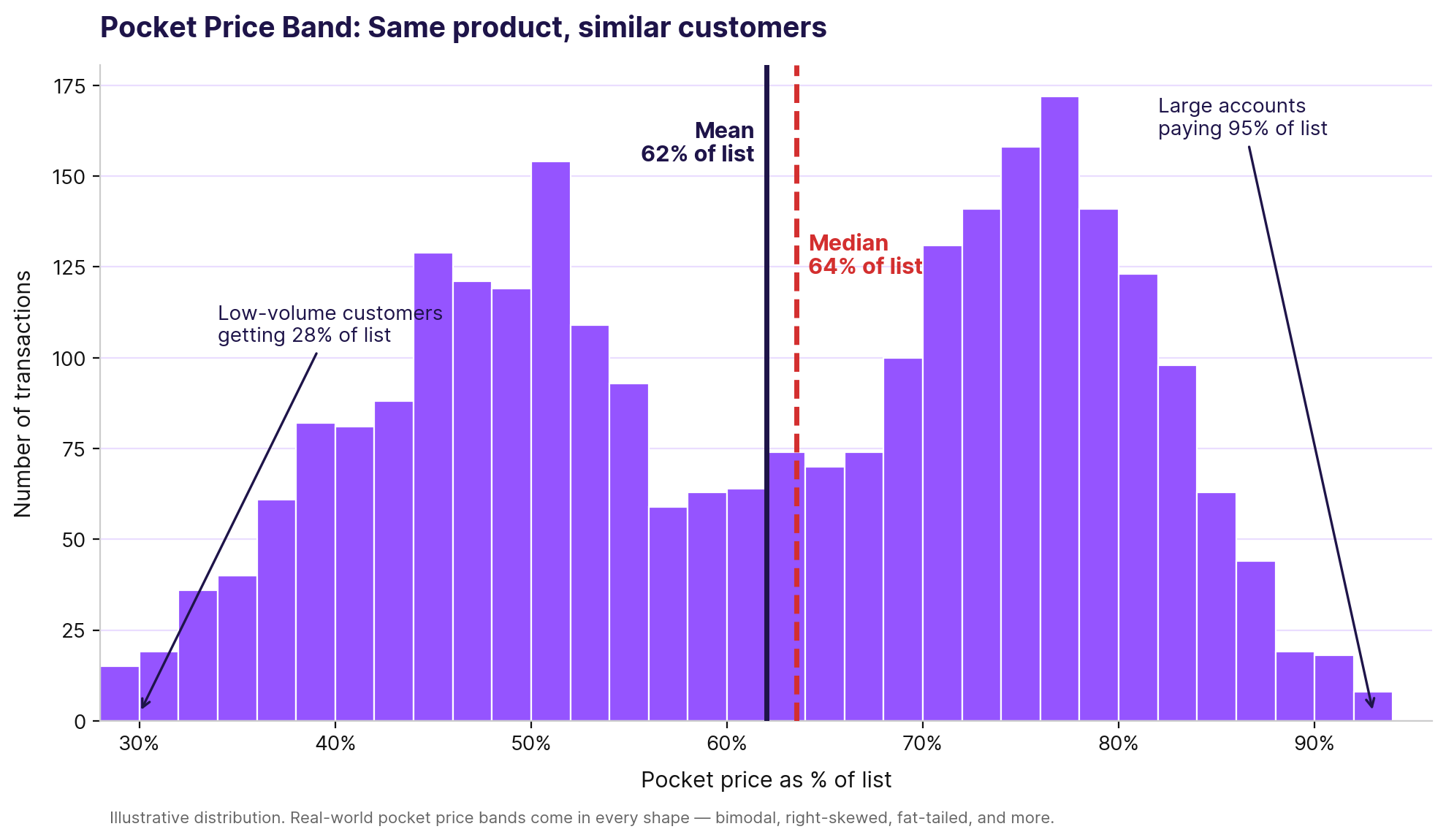
McKinsey's original research on pocket price bands shows that realized prices for the same product, sold to roughly similar customers, routinely range from under 30% of list to more than 90%. In many cases, your low-volume, low-strategic-value customers are getting deeper pocket price discounts than your large, strategic accounts. Experienced buyers at small customers work the waterfall. Newer or less-experienced buyers at large customers don't. If you only look at the average, you will never see this. You have to look at the distribution (think: "bell curve", but of course, it's never a perfect bell shape).

When mid-market manufacturers first plot their pocket price band, the shape almost always surprises them. That surprise is the point. It is the beginning of a real conversation about governance, about conditional versus unconditional discounts, and about where the first 2 to 3 points of margin recovery are sitting.
Here's another way of looking at this point: doing one price waterfall for your whole business is mildly interesting, but since each step in that one summary waterfall is a company-wide roll-up or average... what you really need to be doing is a price waterfall for each product, for each customer, and even for each customer_product combination… this is where the insights live.
How Big Is the Opportunity?
Start with McKinsey's best-known pricing benchmark. For a typical company, a 1% improvement in realized price flows through to roughly an 8% improvement in operating profit (at constant volume and cost). That multiplier is why pricing sits at the top of so many executive agendas once leaders actually see the numbers. See our prior post for more details on this topic.
McKinsey's research across more than 1,000 pricing initiatives puts the typical outcome of a disciplined pricing-excellence program at 200 to 700 basis points of improvement in Return on Sales. BCG's revenue-growth-management work independently lands in the same territory, with clients averaging around 300 basis points of margin improvement. These gains come from recovering margin that was already earned in the transaction but lost during execution, with no change in cost or volume.
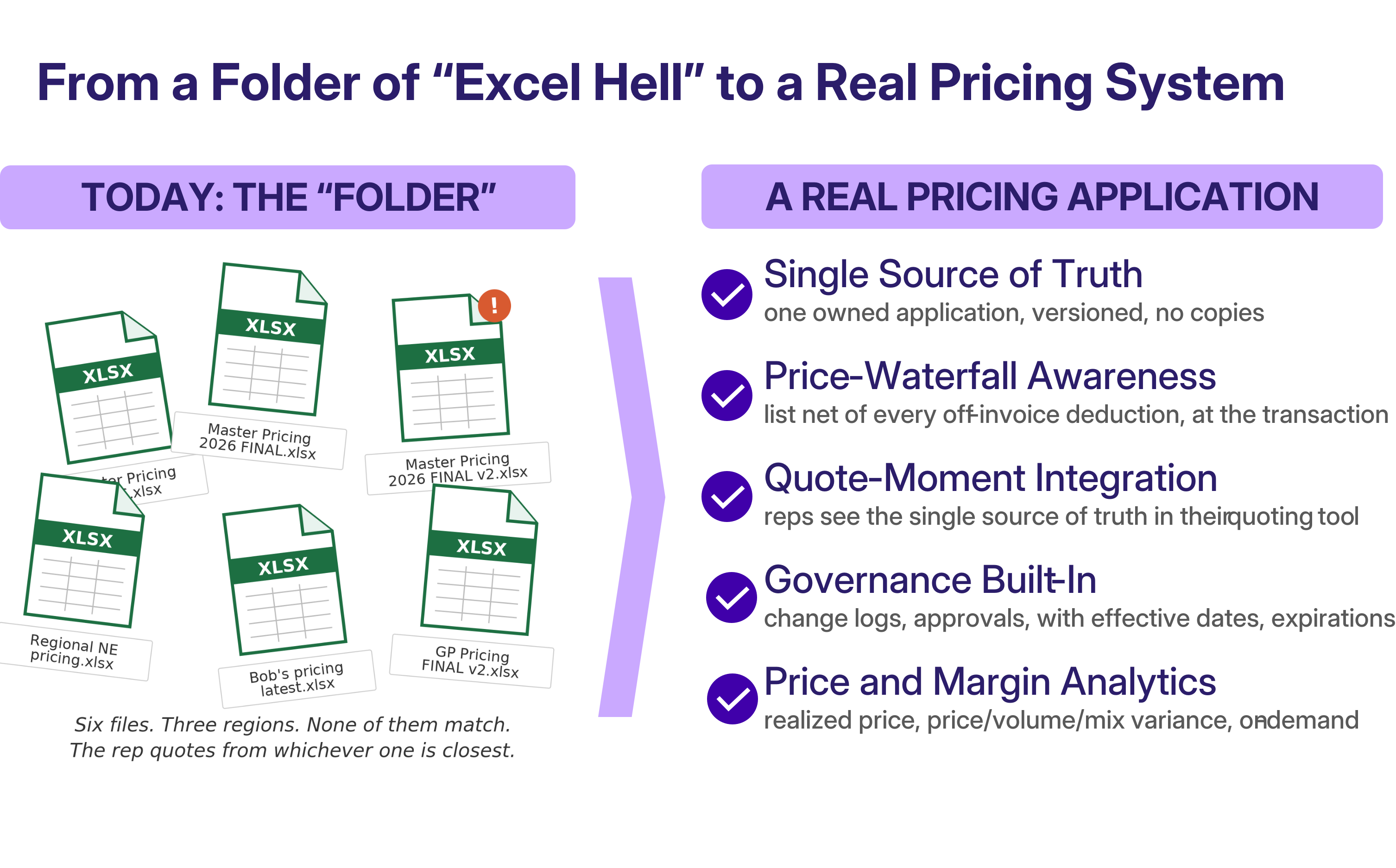
The reason so few mid-market companies capture this value is what is so frustrating to me… because it's not a good reason. The reason is that this decades-old diagnostic is simply not run. The data is there somewhere (it has to be) but pulling it together and representing it the right way isn't easy with Excel. Revomo makes it automatic. The waterfall doesn't fix anything by itself, but you cannot fix what you don't see or measure - and averages don't cut it.
Where to Start
You don't need an expensive consulting engagement to build your first waterfall. You just need your existing transaction and adjustment data, a place that can organize it, and a willingness to look at the resulting chart without flinching.
Revomo is designed to make the first two easy. Sync your existing data (invoices, discounts, rebates, freight, cost-to-serve) and Revomo will structure it into a working waterfall for you. That part is free.
The willingness part is on you.
If you're a B2B manufacturer or distributor curious about what your own waterfall would look like, or you've started down this road and want a second set of eyes on what you're seeing, We'd be glad to help. This is exactly the kind of work we do for our clients at Revomo, and we'd do it free of charge because Revomo AI makes it so easy.
Reach out to us, and let's set it up!
.avif)
in your inbox every week

in your inbox every week

