


Who Actually Owns Pricing in Your Company? (The Answer Might Surprise You)
If everyone owns pricing, no one does. And the result is margin erosion hiding in plain sight.
Ask most mid-sized B2B manufacturers or distributors a simple question — “Who owns pricing at your company?” — and you’ll get an interesting answer. Or more accurately, you’ll get five different answers depending on who you ask.
Product management will tell you they set the list price. Sales will tell you they own the customer relationship, so they own the price. Finance will say they’re responsible for margin performance. Marketing runs the rebate programs. And supply chain is constantly updating costs that feed into pricing calculations.Everyone touches pricing. But nobody owns it.
The fragmentation problem
In most mid-market B2B organizations, pricing isn’t a function — it’s a series of handoffs. Product sets a list price based on cost-plus logic (or sometimes just history). Sales negotiates customer-specific pricing with broad discretion. Marketing creates incentive programs that layer on additional discounts. Finance measures the results after the fact and wonders where the margin went.
Each of these teams is making pricing decisions. But they’re making them independently, with different objectives, different data, and often different definitions of what “margin” even means.
The result is predictable: inconsistent pricing across similar customers, discount dispersion that nobody fully sees, and margin leakage that compounds quietly quarter after quarter. Research from firms like McKinsey and Bain consistently finds that B2B companies leak 5–15% of potential margin through exactly this kind of fragmented execution.
Why this happens
It’s not that anyone is doing something wrong. Each team is doing exactly what they’ve been asked to do. Product is managing cost recovery. Sales is closing deals. Finance is reporting performance. The problem is structural: there’s no connective tissue between these decisions.
Without a central pricing function — or at least a cross-functional pricing process — pricing becomes a byproduct of other functions rather than a discipline in its own right. As Tim Smith argues in Pricing Done Right, pricing failures rarely stem from bad math; they stem from organizational dysfunction. The structures, decision rights, and processes that govern pricing have to be intentionally designed. When they’re not, discounting becomes the default mechanism for resolving any tension in the sales process.
What good pricing ownership looks like
This doesn’t mean you need to hire a Chief Pricing Officer tomorrow (though some companies should). It means you need three things:
Clear decision rights. Who can change a list price? Who can approve a discount beyond a certain threshold? Who decides when and how to execute a price increase? If you can’t answer these questions cleanly, you have an ownership gap.
A cross-functional pricing process. Pricing decisions should be informed by cost data from supply chain, value insights from product and marketing, competitive context from sales, and profitability analysis from finance. That doesn’t happen by accident — it requires a regular cadence and a shared framework.
Visibility into realized price. List price is a starting point. What matters is what you actually collect after discounts, rebates, freight absorption, payment terms, and all the other concessions that erode the price between quote and cash. If you’re only looking at gross margin, you’re probably missing the real story.
The organizational model that works
The most effective pricing organizations in B2B don’t centralize everything — that would be impractical. Instead, they create a hybrid model: a small pricing function (even one person, initially) that owns strategy, governance, and analytics, while sales retains the customer relationship and front-line execution.
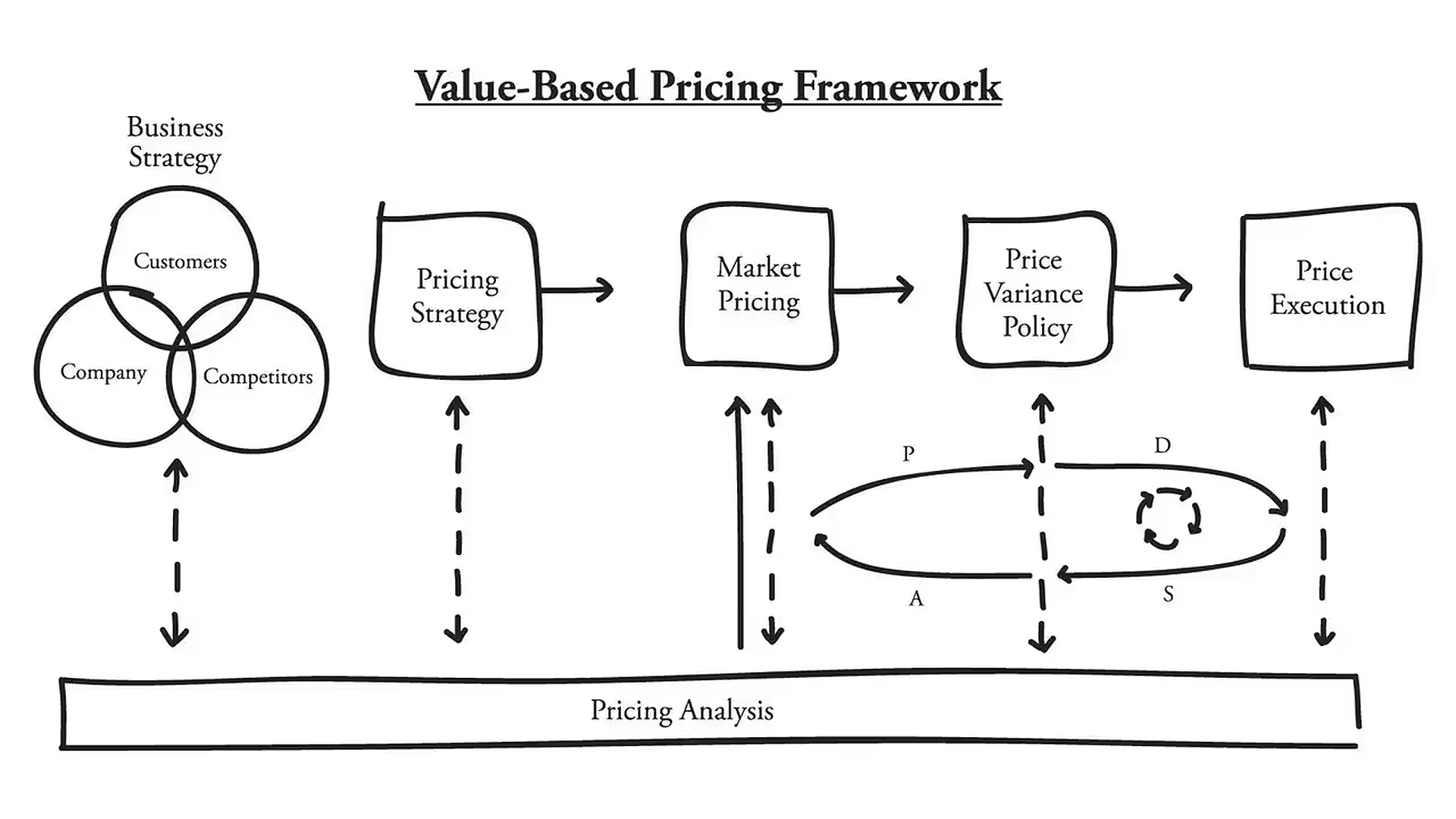
Smith describes the pricing function as a “bridge” between product management, marketing, finance, and sales — and that’s exactly right. Think of it this way: supply chain updates costs. Product sets the base list price. Sales negotiates customer terms. Marketing designs incentive programs. And finance measures the output. Each function owns a piece, but without someone responsible for how those pieces connect, the machine doesn’t run smoothly. Pricing ownership is that bridge — the connective function that aligns all of these decisions around a common set of objectives.
In practice, this often starts with a pricing council — a cross-functional group of leaders from sales, product, finance, and operations who meet regularly to review pricing performance, approve policy changes, and align on strategy. It’s not glamorous. But it’s remarkably effective.
Where to start
You don’t need a pricing transformation to make progress here. Start with a simple audit:
Map every pricing decision your company makes — from list price setting to discount approval to rebate design to price increase execution. For each one, identify who makes the decision, what data they use, and whether anyone reviews the outcome. You’ll likely find gaps, overlaps, and a few decisions that nobody is explicitly accountable for.
That map is your starting point. From there, you can begin clarifying ownership, building a lightweight governance process, and — most importantly — creating visibility into what’s actually happening to your realized prices.
Pricing is the most direct path to margin improvement — it’s just math. But math only works when someone is accountable for it.
So here’s the question: Who owns pricing at your company today? Not in theory. In practice.
.avif)
in your inbox every week

in your inbox every week

