


The 5 Biggest Pricing Myths in B2B Manufacturing & Distribution

“The market sets the price” is not a pricing strategy. It’s a margin-surrender strategy.
Most B2B manufacturers and distributors run sophisticated operations: optimized supply chains, lean production floors, and carefully managed customer relationships. And then they often leave price management and negotiations to gut feel, spreadsheet spaghetti, and competitive knee-jerk reactions.
These are five of the most common myths I’ve heard and seen in 20 years of pricing. If you recognize your organization in any of them, that’s not a critique; it’s an opportunity.
Myth 1: The Market Sets the Price
This is number one, by far. I’ve heard it in nearly every industry. It can be a capitulation, an excuse for not knowing what to do, or what some people honestly believe is enlightened pricing (market-based pricing).
It’s true that the market sets a range; but not a single price in a given situation. Within that range, you have more room to maneuver than most companies realize. Where you should price within your market depends on things like your value proposition, your customers’ next-best alternative, your ability to communicate your value and differentiation, and frankly, your sales team’s confidence.
An old boss of mine used to say, “Yeah, there’s a market price range… but where you fall within that range, and the margins we subsequently capture; that’s your job. That’s part of what you get paid for.”
Myth 2: Sales Teams Know the Best Price
This one is tempting, because there’s a lot of truth to the notion that your salespeople know your customers better than anyone — especially when you’ve got a strong sales team.
The truth is that a salesperson knows their customers. Absolutely. But they don’t know everyone else’s customers.
Bob, who manages a territory in Cleveland, might know his customer really well. But does Bob know what similar customers are paying for the same product in Seattle? Or in New York?
What if we could give Bob insight that his Cleveland customer is actually paying one of the lowest prices in the country for that product? Would that change Bob’s context, his negotiating position, or his behavior?
In short, a salesperson may have strong insight into their book of business, but they usually have — by design — a narrow context and simply don’t have the broader information that would help them improve outcomes.
Myth 3: B2B Purchasing Is Purely Logical
I’ll admit that I believed this myth at one point as well. I started in B2C pricing and assumed (like many people) that B2B buyers make decisions based on logical, rational frameworks, because they’re at work and making business decisions.
But the reality is that buyers and sellers in B2B are still human. And research consistently shows that humans rarely make purely rational decisions. We make decisions based on a cocktail of emotion, fear, greed, and maybe a little reason. Then we rationalize them to ourselves and our colleagues later.
Risk aversion. Fear of making the wrong call. Friendship and trust in vendor relationships. The desire to look competent to internal stakeholders. These factors shape commercial decisions in meaningful ways.
Pricing nerds like me love to talk about Value-Based Pricing or Economic Value Estimation. But even value perception is, at least in part, subjective.
Pricing that ignores the emotional dimension of B2B decisions is pricing that leaves influence — and margin — on the table.
Myth 4: Cost-Plus Is the Only Fair Way to Price
Cost-plus pricing is admittedly simple, feels defensible, and is usually the worst way to set prices.
To be clear: understanding your costs and whether you’re generating profit is important. And yes, if global markets for a key input drop significantly, there will likely be pressure from buyers to lower your prices.
But basing your entire pricing methodology on your costs ignores key realities — like the fact that some buyers are willing to pay more (and less) than others. Your costs might be the same, but customers’ willingness to pay varies.
Different buyers have different reasons for buying your products or services. Different buyers have different alternative options. A competitor could suddenly lose significant production capacity (by choice or circumstance), and that changes the market dynamics. Cost-plus pricing would tell you to do nothing.
What if your procurement team negotiates a brilliant new set of supply chain contracts and reduces direct material and shipping costs by 8%? Cost-plus pricing would have you hand that 8% directly to customers.
The value created by your operations or procurement teams would not be realized by your company — it would be realized by your customers’ procurement teams.
Myth 5: Our ERP Handles Pricing
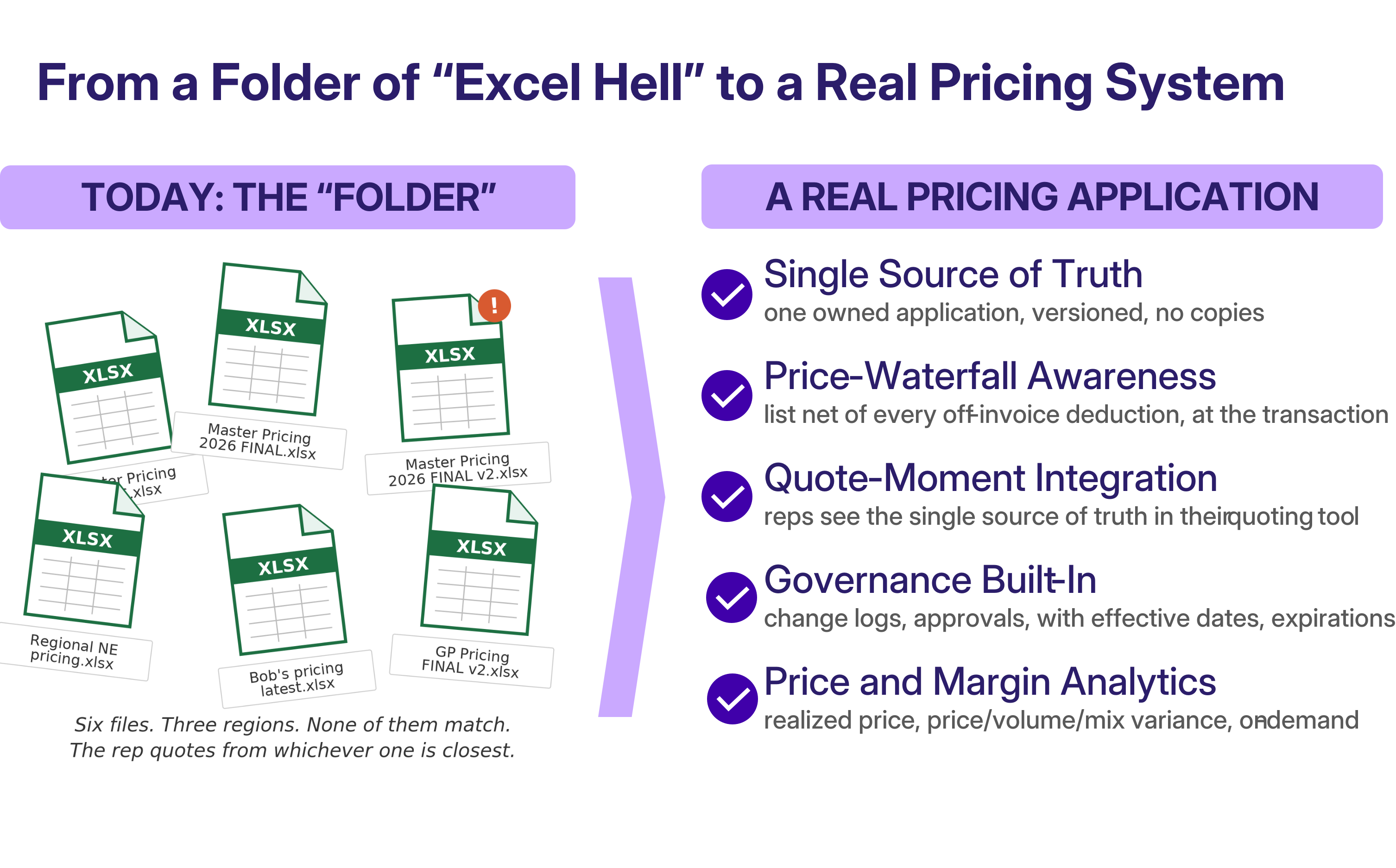
Yes, every ERP system can handle pricing execution. You need a price to put on an invoice or an order.
But while ERPs store prices and execute transactions, they do not systematically manage prices — much less optimize them.
Price setting, optimization, and negotiation require dynamic, market-oriented inputs that simply are not present in ERP systems.
There’s a reason companies like SAP and Oracle partner with specialized pricing software providers when customers need a serious pricing solution. It’s a tacit acknowledgment that ERP systems are not built for price management and optimization.
Final Question
Which myth do you hear most often in your organization or industry?
Drop it in the comments. I’d genuinely like to know which one resonates — and which ones I missed.
.avif)
in your inbox every week

in your inbox every week

